The 7.65% Your Employer Should Not Be Taking
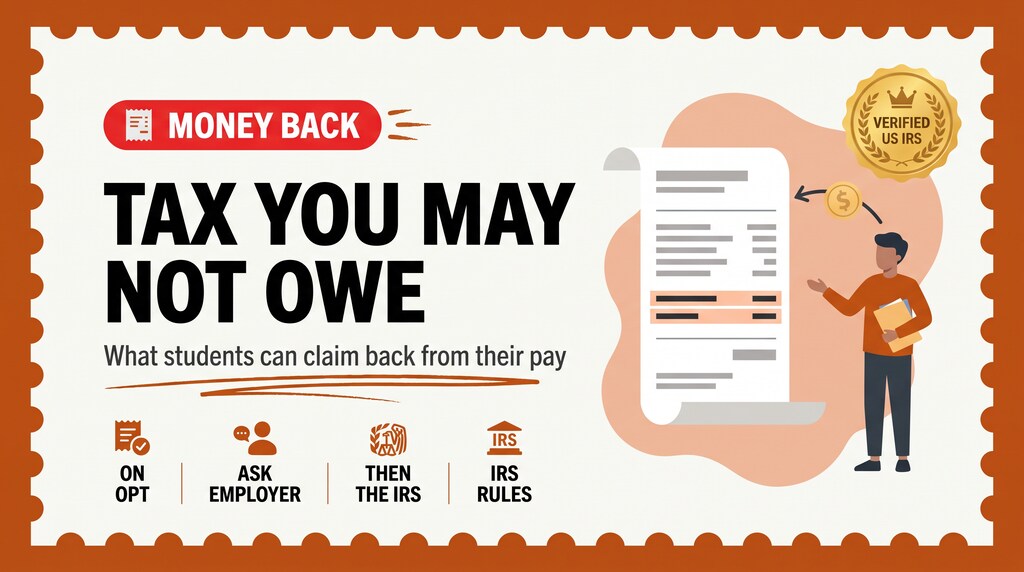
Social Security and Medicare take 7.65% of an American pay cheque. If you are an F-1 student on OPT in your first five calendar years, the IRS says you generally should not be paying it — and many employers deduct it regardless.
In this guide (6 sections)
Look at your US payslip. Two lines take 7.65% of your gross pay before anything else: Social Security at 6.2% and Medicare at 1.45%. Together they are called FICA.
On a $70,000 OPT salary that is $5,355 a year. On a $30,000 campus-adjacent job it is $2,295. And if you are an F-1 student in your first five calendar years in the US, the IRS position is that you generally should not be paying it at all.
Employers still deduct it, routinely. Payroll systems are built for US workers and a student's visa status is not something the system checks.
Which work is covered
The exemption applies where the work itself is permitted by your status and serves the purpose the visa was issued for. The IRS lists:
- On-campus student employment, up to 20 hours a week (40 during summer vacations)
- Off-campus student employment authorised by USCIS
- Practical training employment, on or off campus — which is what OPT and CPT are
When it does not apply
• spouses and children in F-2, J-2 or M-2 status
• employment not authorised by USCIS, or not closely connected to the visa's purpose
• students who change to an immigration status that is not exempt
• students who have become resident aliens
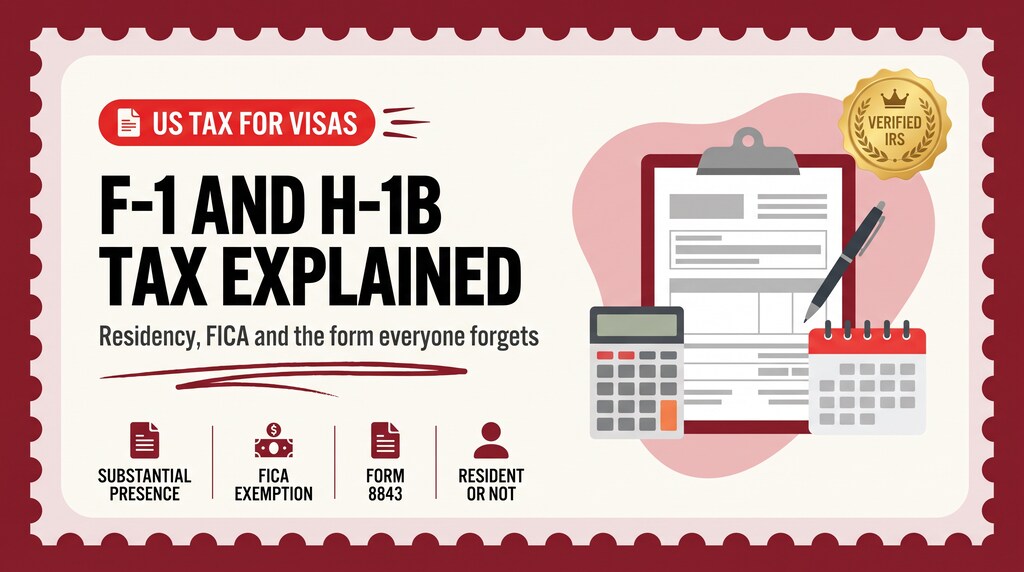
That last one is the trap. After more than five calendar years in F-1, J-1 or M-1 status you generally become a resident alien for tax purposes if you meet the Substantial Presence Test — and from that point FICA applies.
There is a second, separate exemption that can still help. Under Internal Revenue Code section 3121(b)(10), students employed by the school, college or university where they are enrolled at least half-time are exempt from FICA regardless of tax residency, provided the work is incidental to the course of study. On-campus only — off-campus jobs and outside employers do not qualify.
And note the obvious one: once you move to H-1B you are not an exempt student. FICA applies, and it should.
How to claim it back
The IRS sets out a two-step order, and the order matters.
- Ask your employer first. If Social Security or Medicare tax was withheld in error, you contact the employer who withheld it and request a refund. Many will correct it in payroll, which is faster than anything the IRS can do.
- If the employer will not refund it in full, claim from the IRS. File Form 843 (Claim for Refund and Request for Abatement) together with Form 8316 (Information Regarding Requests for Refund of Social Security Tax Erroneously Withheld on Wages Received by a Nonresident Alien on an F, J or M Type Visa), with supporting documents.
Form 8316 exists precisely because this situation is common enough to need its own form. That is a useful thing to know when an employer tells you the deduction cannot be wrong.
What to gather before you ask
- Your Form W-2 showing the Social Security and Medicare amounts withheld
- Your Form I-20 and the EAD card if you are on OPT
- Your visa page and the I-94 record covering the period
- A written record of the refund request you made to the employer, and their reply or refusal
Count your calendar years carefully, because the rule counts calendar years and not twelve-month periods. Arriving in August 2022 means 2022 already counts as one of your five.
Why this is worth the afternoon
It is 7.65% of gross pay, for every year it was wrongly taken. Against the $66,262 median first-year earnings of a US master's graduate, a full year of wrongly withheld FICA is about $5,069. Two years of OPT at that level is over $10,000.
If you are also working out what you should be earning, see our H-1B salary data by role and city and what a US master's pays back by field. The wider tax picture is in US tax on F-1 and H-1B.
What this article is not
This is information, not tax advice, and your position turns on facts we cannot see — your exact entry dates, status changes, days present, and whether a totalization agreement applies. The IRS notes that the US has such agreements with several countries and that they must be taken into account.
Residency for tax purposes is not the same thing as immigration status, and the Substantial Presence Test has its own rules for counting days. If a material amount of money is involved, have a qualified tax preparer who handles nonresident returns check the position before you file.
Questions
Do F-1 students have to pay Social Security and Medicare tax?
Does the FICA exemption cover OPT?
How do I get a FICA refund if my employer withheld it?
How much money is this worth?
What happens after five years in the US?
Sources: IRS — Foreign Student Liability for Social Security and Medicare Taxes · IRS — Topic No. 751, Social Security and Medicare Withholding Rates · IRS — Taxation of Nonresident Aliens · IRS — Substantial Presence Test