The Proposed $70,000 OPT Fee: Who Actually Pays, and What It Would Change
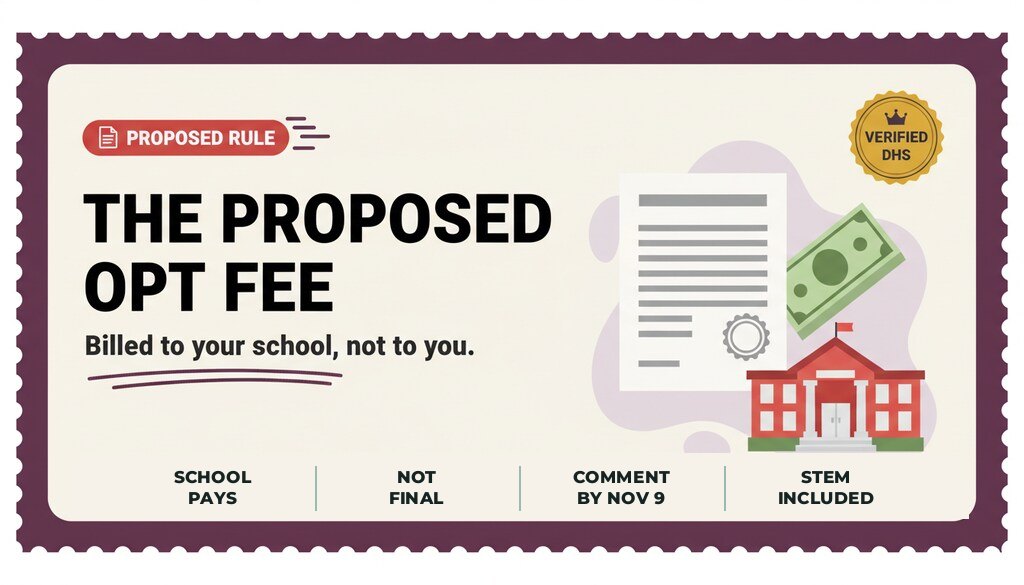
DHS has proposed $70,000 for a first OPT authorisation and $30,000 for each one after. The fee is billed to your school, not to you — and DHS's own analysis contemplates schools recommending only STEM students.
In this guide (7 sections)
DHS has proposed charging $70,000 for a student's first OPT authorisation and $30,000 for every one after it.
Those numbers are real, and they are not a typo. But almost every summary circulating about them gets the central fact wrong, and the deadline to say anything about it is days away.
The part most coverage gets wrong
The fee is not billed to you. It is payable by your school.
DHS's own wording: the rule would establish a fee of $70,000 per F-1 student "applicable to SEVP-certified schools that recommend an F-1 nonimmigrant student to engage in OPT for the first time". It is a one-time payment the institution must make before a DSO's initial OPT recommendation.
The summary paragraph at the top of the rule reads as though the student pays, which is where the confusion comes from. The operative text does not say that.
What is actually proposed
| Initial OPT | Any subsequent OPT | |
|---|---|---|
| Amount | $70,000 | $30,000 |
| Paid by | The SEVP-certified school, per student | |
| When | Before the DSO's first OPT recommendation | Before each later recommendation |
| Covers | Any first OPT — pre- or post-completion | Any later OPT, including the STEM OPT extension |
| Proposed provision | 8 CFR 214.2(f)(11)(ii), 214.13(i)(1) | 8 CFR 214.13(i)(2) |
Two further details from the text:
- The fee is not tied to an employer. DHS states it applies "when a school decides to recommend an F-1 nonimmigrant student for any type of OPT", and is not triggered by changing employer.
- The $30,000 covers the STEM OPT extension. So a STEM student who does post-completion OPT and then the 24-month extension sits behind $70,000 and then $30,000 — a $100,000 commitment from the institution for one student.
The sentence in DHS's own analysis worth reading twice
In modelling the effects, DHS describes a low participation scenario — one where "DSOs recommend only the prospective STEM OPT F-1 nonimmigrant students for OPT", producing costs for "prospective non-STEM OPT F-1 nonimmigrant students unable to participate in OPT".
DHS also notes that "affected parties could collectively cost share to preserve OPT" — which is an acknowledgement that someone has to find the money, and that it will not simply be absorbed.
Context DHS provides
The rule states that in 2024 about 20 percent of F-1 nonimmigrants participated in OPT, out of roughly 1.4 million F-1 nonimmigrants. DHS argues the opportunity to do OPT is only one of many factors in choosing an institution — alongside location, rankings, programme availability and tuition — and that treating it as the sole reason a student came to the US would be speculative.
DHS states the purpose of the fees is to combat fraud, strengthen immigration system integrity and protect US workers.
You can comment, and the window is almost shut
This is the actionable part, and it is time-critical.
| Item | Detail |
|---|---|
| Comments due | 9 November 2026 |
| Information-collection comments | 7 December 2026 |
| Docket | DHS Docket No. ICEB-2026-0100 |
| Where | The Federal eRulemaking Portal at regulations.gov |
Public comment on a proposed rule is a real mechanism, open to anyone — you do not need to be a US citizen or resident to file one. Agencies must consider substantive comments before finalising.
A comment that describes a concrete, specific effect carries more weight than one that simply objects. If you are affected, say precisely how: your programme, your situation, and what would change for you.
What to actually do now
- Do not panic or change plans on a proposal. Nothing is in force. Rules get altered and withdrawn.
- Comment before 9 November if you have something specific to say.
- Ask your school directly: "If this rule is finalised, will you still recommend students on my programme for OPT?" Their answer is the single most useful piece of information you can get, and it is a fair question to ask admissions before you commit.
- If you are weighing programmes, ask about the CIP code now. Under the low participation scenario DHS itself describes, STEM-eligible programmes are the ones schools would be likeliest to keep funding. Our MS earnings guide covers why the CIP code matters.
- Understand the alternatives. If OPT narrows, the routes that do not depend on it matter more — see our H-1B cap guide and the L-1 route.
- Follow the docket rather than social media summaries. The primary documents are linked below.
What we have not published
We have not predicted whether this will be finalised, in what form, or when — nobody honestly can. We have not estimated what schools would charge students if they chose to pass the cost on, because the rule does not address that and any number would be invention. And we have not reproduced DHS's full economic analysis; the complete document is linked below and is worth reading directly if this affects you.
We will update this guide when the rule is finalised, withdrawn or changed.
Questions
Is the $70,000 OPT fee real?
Would I have to pay $70,000 for OPT?
Does the fee cover the STEM OPT extension?
Is the fee charged again if I change employer?
Could schools stop offering OPT recommendations?
When is the comment deadline?
Can I submit a comment if I am not a US citizen?
How many F-1 students actually use OPT?
Sources: Federal Register — Optional Practical Training Fees (proposed rule, 8 Oct 2026) · Regulations.gov — DHS Docket ICEB-2026-0100 (submit a comment) · DHS Study in the States — STEM OPT Hub · ICE — Practical Training (CPT and OPT)