The H-1B Route With No Lottery
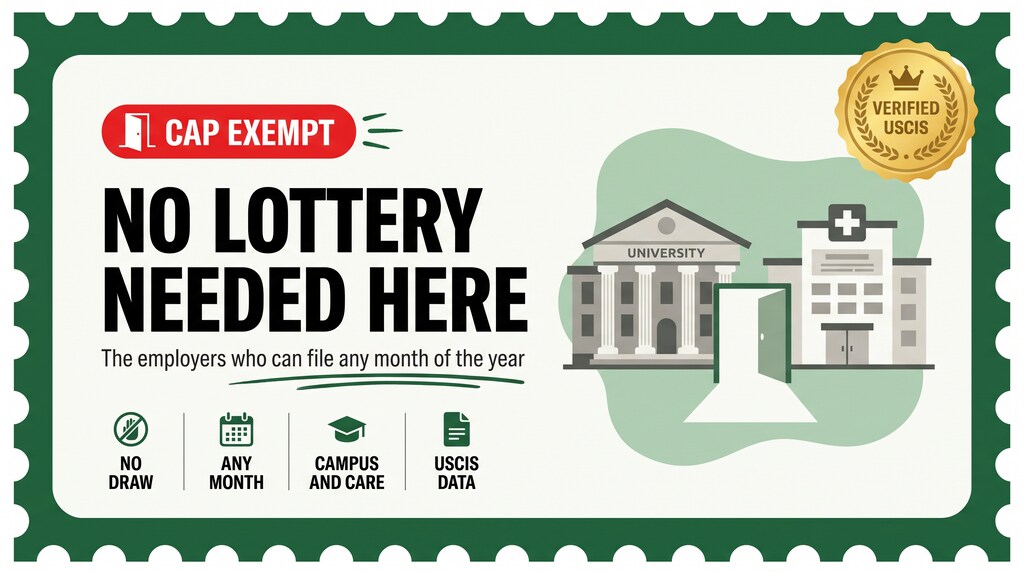
If you lose the H-1B lottery, one group of employers can still file for you — any month, no registration, no draw. In the federal data they are one in seven of all first-time approvals and are refused at half the national rate.
In this guide (5 sections)
Every March, Indian graduates in the US put their name into a draw for 65,000 H-1B places, plus 20,000 more reserved for people holding a master's degree or higher from a US institution. Most do not get picked. A large number conclude their American career is over.
It is not, because that draw does not cover everyone. USCIS states plainly that not all H-1B petitions are subject to the annual cap, and gives US institutions of higher education as its example of petitioners that are cap exempt.
This is not a niche route
We aggregated the USCIS H-1B Employer Data Hub for fiscal year 2022, the most recent complete year published for download. Filtering to universities, hospitals, medical centres and research institutes:
| Measure | Universities, hospitals & research | All employers |
|---|---|---|
| Employers in the file | 3,285 | 51,664 |
| Initial approvals | 18,733 | 138,381 |
| Share of all initial approvals | 13.5% | — |
| Initial denial rate | 1.16% | 2.21% |
Roughly one in seven first-time H-1B approvals went to this group — and they were refused at about half the national rate.
The biggest academic and medical sponsors
| Employer | Initial approvals | Initial denial rate | Continuing approvals |
|---|---|---|---|
| Stanford University | 321 | 0.93% | 209 |
| University of Michigan | 245 | 0.41% | 269 |
| Mayo Clinic | 242 | 0.41% | 161 |
| Columbia University | 184 | 0.54% | 124 |
| University of Wisconsin–Madison | 173 | 0.57% | 160 |
| Icahn School of Medicine at Mount Sinai | 155 | 0.00% | 113 |
| Johns Hopkins University | 155 | 0.00% | 130 |
| University of Maryland | 149 | 0.67% | 149 |
| Cleveland Clinic | 144 | 0.69% | 180 |
| University of Pennsylvania | 144 | 0.69% | 127 |
| University of Chicago | 142 | 0.00% | 89 |
| Harvard University | 140 | 2.78% | 78 |
| National Institutes of Health | 140 | 0.00% | 162 |
| Yale University | 135 | 0.00% | 87 |
Five of those fourteen refused nobody at all.
What the jobs actually are
The common assumption is that this route means becoming an academic. The filings say otherwise. A university employs data engineers, statisticians, software developers, clinical research coordinators, biomedical engineers, financial analysts and IT staff, and a teaching hospital employs the same plus a large clinical and laboratory workforce.
The pay is usually below a product company's. The trade is a real one: lower salary, no lottery. For someone facing the alternative of leaving the country, that is not a close call.
How to work this route
- Search university and hospital career pages directly, not only the big job boards. Many post exclusively on their own systems.
- Apply year-round. The entire advantage is that there is no March window, so a September vacancy is as good as a February one.
- Ask HR one question: does your institution file cap-exempt H-1B petitions? University HR teams answer this routinely because they do it every year.
- Check the employer in the data hub the same way you would any sponsor — see our guide to denial rates by employer.
- Understand what happens if you leave. Moving from a cap-exempt employer to a normal company does not carry the exemption with you; that move generally puts you back into the cap.
What this data cannot tell you
Whether a specific employer is cap exempt is a legal determination, not something you can read off this table. The USCIS cap season page names US institutions of higher education as an example of cap-exempt petitioners. Affiliated medical centres, nonprofit research bodies and government research organisations are commonly treated as exempt too, but that depends on the institution's own status and relationships — confirm it with the employer and, for anything consequential, an immigration attorney.
Our grouping is a keyword match on employer names in the file, so it will pick up some employers that are not in fact cap exempt and miss others that are. The 18.3% share should be read as the scale of academic and medical sponsorship, not as a precise count of cap-exempt petitions.
FY2022 is the latest complete downloadable year. A FY2023 file exists but holds roughly a quarter of FY2022's volume and appears to be a partial-year export, so we do not use it for shares or rates. And a low denial rate reflects the kind of roles these institutions file, not a promise about your own case.
Questions
What is a cap-exempt H-1B?
Can I get an H-1B if I lose the lottery?
Are cap-exempt petitions more likely to be approved?
Do I have to be a researcher or professor?
What happens if I move from a cap-exempt employer to a normal company?
Sources: USCIS — H-1B Cap Season · USCIS — H-1B Employer Data Hub · USCIS — H-1B Employer Data Hub annual files (archive) · USCIS — H-1B Specialty Occupations