Your Visa, Your I-94 and Your I-20: Which Date Actually Governs
Three documents, three dates, and only one decides how long you may legally stay. An expired visa is not a status problem — and a valid one is not permission to remain.
In this guide (8 sections)
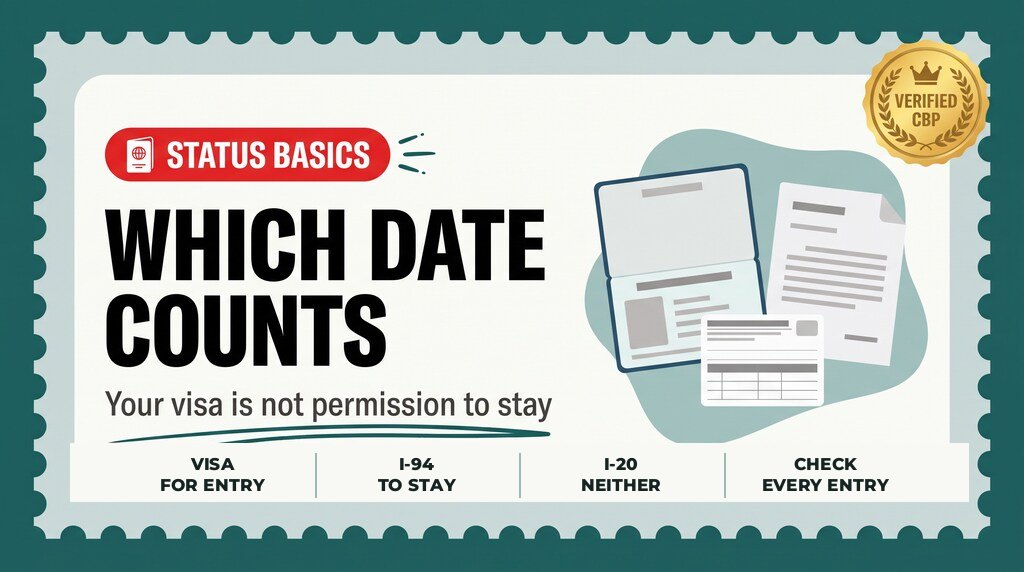
Three different documents give you three different dates, and only one of them decides how long you can legally stay. People get this wrong constantly, and under the rules that took effect in September 2026 the cost of getting it wrong went up sharply.
The three dates, and what each one actually governs
| What it is | What it controls | |
|---|---|---|
| Visa (the sticker in your passport) | Permission to travel to a US port of entry and ask to be admitted | Entry only. It can expire while you are lawfully inside the US and that is fine. |
| Form I-94 | Your arrival/departure record, issued at admission | How long you may stay. The "admit until" date is the one that governs. |
| I-20 / I-797 | Your programme or petition document | Your eligibility and your programme or employment dates — not your authorised stay. |
Why this suddenly matters more
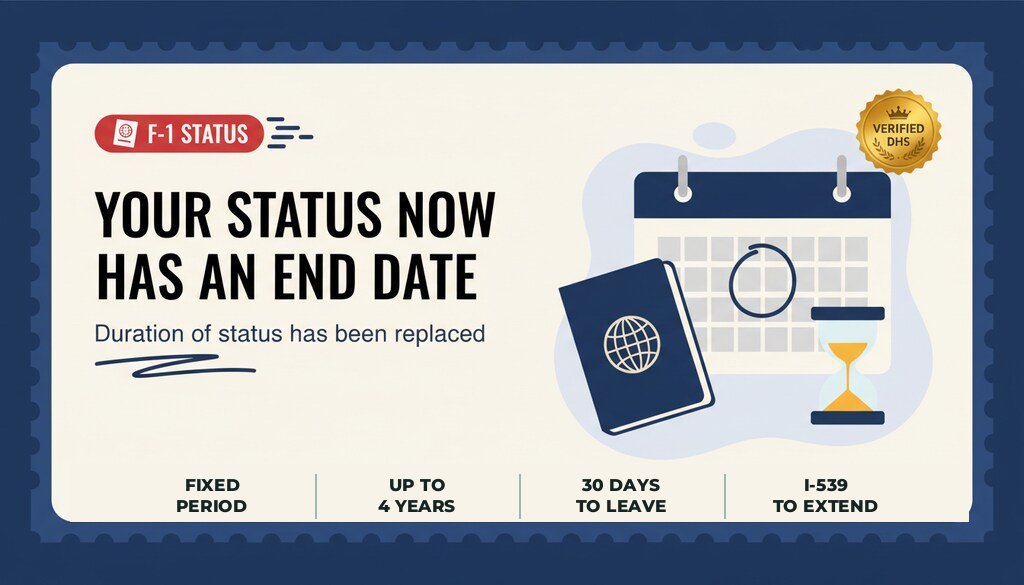
Until recently, an F-1 I-94 usually said D/S — duration of status. There was no date to overstay as long as you kept making progress.
A DHS final rule in force since 15 September 2026 replaced that with a fixed admission period for the F, J and I classifications. Your I-94 now carries a real end date, and passing it has the ordinary consequences of overstaying. We cover that rule in detail in our guide to the fixed admission period.
If you are on an H-1B, your I-94 has always carried a date — and it is the date that decides how long your grace period runs if you lose your job. USCIS states the period after employment ends is up to 60 consecutive days or until the end of your authorized validity period, whichever is shorter. That second half is your I-94. See our layoff guide.
How to actually get your I-94
You retrieve it yourself from CBP's I-94 website. You do not get a paper card at most airports any more — the record is electronic, and the version on that site is the authoritative one.
- Go to CBP's I-94 site (linked below) and choose to retrieve your most recent I-94.
- Enter your details exactly as they appear in your passport.
- Read the Admit Until Date. Write it down.
- Check the class of admission too — F-1, H-1B, H-4 and so on. It should match what you expect.
One formatting change worth knowing
CBP has moved to a new I-94 number format that includes letters as well as digits. CBP states that unexpired I-94s issued in the older numeric-only format remain valid until the admit until date printed on the paper I-94 or shown on the I-94 website. So an older-format number is not a problem.
Common mistakes
- "My visa is valid until 2029, so I can stay until 2029." No. The visa is for entry. Your I-94 decides your stay.
- "My I-20 runs to next June, so I am fine until June." Not necessarily. Under the fixed admission period your I-94 may end earlier, and the I-94 governs.
- "My I-797 approval runs to 2028." Check the I-94 attached to it. If you entered on an older admission, the dates can differ.
- "I did not get a paper I-94, so I do not have one." You almost certainly do — electronically, on the CBP site.
- "The dates will match." Often they do. When they do not, the I-94 wins.
If your I-94 is wrong
It happens — a wrong class of admission, a date that does not match your petition, or a missing record after a land entry. It is worth fixing promptly rather than hoping, because you will be judged against what the record says.
CBP's I-94 site has a process for correcting records, and for errors made at entry the usual route is a CBP deferred inspection office. Your DSO (for F-1) or your employer's immigration counsel (for H-1B) should be told immediately, because the fix often needs documents they hold.
If you need more time
USCIS states you may apply to extend your stay if you were lawfully admitted on a nonimmigrant visa, your status remains valid, you have not committed crimes making you ineligible, you have not violated the conditions of your admission, and your passport is valid.
The critical part is timing: apply before your authorised stay expires. Filing after the date has passed is a very different and much worse conversation.
A two-minute habit worth building
- After every US entry, pull your I-94.
- Save a PDF copy with the date in the filename.
- Put the admit until date in your calendar with a reminder six months ahead.
- Compare it against your I-20 or I-797 and note any mismatch.
- If anything looks wrong, raise it that week — not that year.
What we have not published
We have not set out the correction procedure step by step, or the filing fees and processing times for extension applications — those are set by CBP and USCIS and change. We have also not covered automatic revalidation for short trips to Canada or Mexico, which has its own conditions.
This is general information, not legal advice. If your I-94 does not say what you expect, that is a situation to raise with your DSO or an immigration attorney rather than to reason through alone.
Questions
What is the difference between my visa and my status?
Which date decides how long I can stay?
Where do I find my I-94?
Does my I-94 change when I travel?
My I-94 number has letters in it. Is that a problem?
Do F-1 students still get D/S on the I-94?
What if my I-94 has the wrong class of admission or dates?
When should I apply to extend my stay?
Sources: CBP — Form I-94 Arrival/Departure Record (official site) · CBP — I-94 information page · USCIS — Extend Your Stay · Federal Register — Establishing a Fixed Time Period of Admission (final rule, 17 Jul 2026)