One Job Title Holds Three in Ten H-1Bs
No other occupation comes close. Nearly a third of every certified H-1B filing carries one job code — and the pay data for it contains a warning the headline median hides.
In this guide (5 sections)
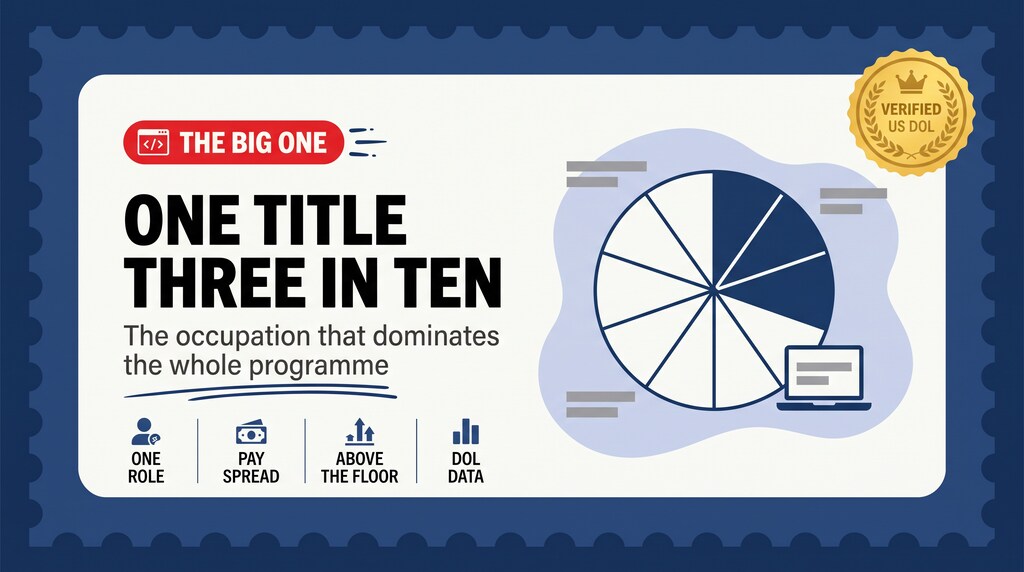
Across 391,748 certified H-1B filings, one occupation code appears 118,662 times. Software Developers are 30.3% of the entire file. The second-largest occupation, Data Scientists, has 18,263 — fewer than a sixth as many.
That concentration makes this one occupation worth looking at on its own.
The full distribution
| Measure | Software Developers |
|---|---|
| Certified filings | 118,662 |
| 25th percentile | $115,894 |
| Median | $144,936 |
| 75th percentile | $177,861 |
| 90th percentile | $212,202 |
| Median prevailing wage (legal floor) | $131,997 |
| Premium over the floor | 9.8% |
The spread from the quarter-line to the ninetieth percentile is $96,308 — the bottom of the range is 55% of the top. Two people with the same job title, the same visa and the same year can be $96,000 apart.
The warning the median hides
That is one of the thinnest premiums of any large occupation in the file. For comparison, Management Analysts run 27.9% above their floor, Financial Quantitative Analysts 45.2% and Computer and Information Research Scientists 25.9%.
A thin premium means the wage is being set substantially by the published prevailing-wage tables rather than by employers competing for you. It is the same signal we found in the occupations paid at the floor, and it is surprising to find it in the most in-demand job title in the file.
It also explains why so many Dallas-area offers land on one exact number: when the premium is thin, the floor does most of the work.
What this means when you negotiate
- Do not cite the prevailing wage. At 9.8% above it, quoting the floor is quoting a number close to the offer. It helps the employer.
- Cite the percentile instead. "This is below the 25th percentile of certified filings for this occupation" is factual and checkable, and $115,894 is the line.
- Cite the city. The spread between cities for this occupation is larger than the spread between most employers — see salary data by role and city and the cost-adjusted version.
- Consider the adjacent codes. Computer and Information Systems Managers run a $208,000 median and Research Scientists $190,000. Both are filed far less often, and both pay substantially more than the title that three in ten filings carry.
The concentration is itself a risk
When 30% of a visa programme sits in one occupation, anything that changes how that occupation is adjudicated moves the whole market. The fifteen-year denial series shows how quickly that can happen, and which employers absorbed it when it did.
It is also why the other 273,086 filings are worth knowing about. Seven in ten certified filings are for something other than this job title, and fourteen occupations out-earn it.
What this data cannot tell you
These are national figures across every city and seniority level. A Software Developer median in Sunnyvale and one in Plano are different numbers, and the national median sits between them.
The occupation code covers a very wide range of work, from a first job writing CRUD endpoints to a staff engineer on a compiler team. The code does not distinguish them, which is a large part of why the distribution is so wide.
Wages are base pay promised to the Department of Labor. Bonus and equity are excluded, and for this occupation in particular they form a large part of senior compensation — so the top of the real distribution is well above $212,202.
Questions
What percentage of H-1B visas go to software developers?
What is the median H-1B salary for a software developer?
How far above the legal minimum are software developers paid?
Should I use the prevailing wage when negotiating a developer offer?
Which related job codes pay more?
Sources: US Department of Labor — Foreign Labor Certification Performance Data (LCA disclosure files) · US Department of Labor — Prevailing Wage Information and Resources · US Department of Labor — Labor Condition Application (LCA) programme