The STEM OPT Extension, Step by Step: Eligibility, Form I-983 and E-Verify
Twenty-four more months of work authorisation — if your degree, your employer and your training plan all qualify. What USCIS and the STEM OPT Hub actually require, in the order you will need it.
In this guide (7 sections)
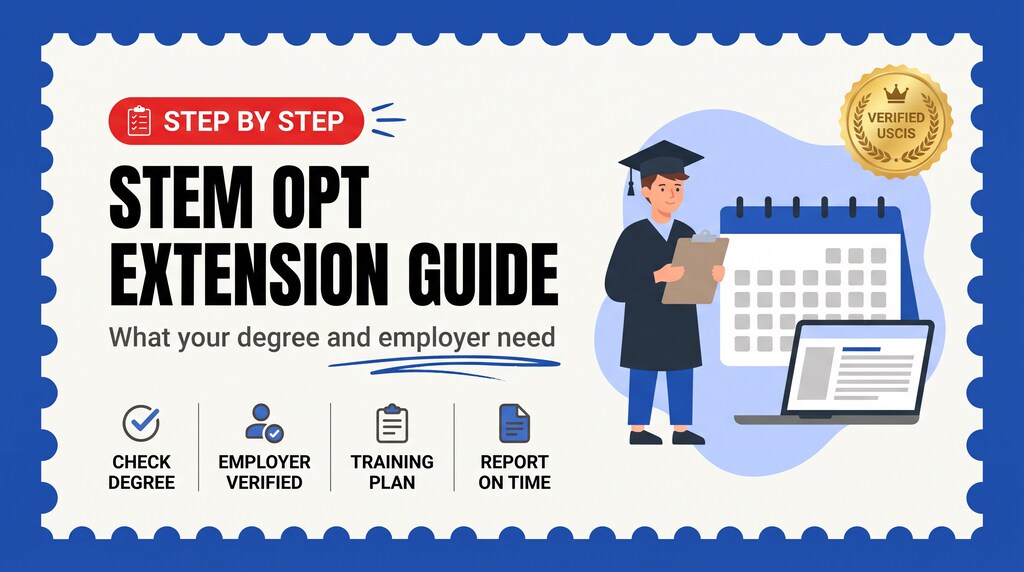
For most Indian students with a STEM degree, the STEM OPT extension is what makes the H-1B lottery survivable: it adds 24 months of work authorisation on top of the first year of post-completion OPT, which means up to three chances at the lottery instead of one. But it has more moving parts than regular OPT — your degree, your employer and a formal training plan all have to qualify. Our OPT and STEM OPT overview covers the basics; this guide is the step-by-step.
1. Check that you qualify
USCIS lists the requirements. You must:
- have been granted OPT and currently be in a valid period of post-completion OPT;
- hold a bachelor’s, master’s or doctoral degree from a school that is accredited by a Department of Education-recognised accreditor and certified by SEVP when you apply;
- have a degree on the DHS STEM Designated Degree Program List;
- work for an employer that meets the STEM OPT employer requirements (below).
2. Make sure your employer can sponsor it
This is where most STEM OPT plans fail. The employer must:
| Employer requirement | What it means for you |
|---|---|
| Enrolled in E-Verify and in good standing | You will need its E-Verify company ID number on your application |
| Valid IRS Employer Identification Number | A real employer, not a placeholder |
| Bona fide employer-employee relationship | No “employer in name only”, and no volunteer arrangements |
| Formal training programme, with its own staff or contractors as trainers | Trainers cannot be the client’s employees, and never another OPT student |
| Duties, hours and pay comparable to similarly situated U.S. workers | Cannot be a cheaper version of a U.S. job |
The employer that signs your training plan must be the same entity that actually trains you. That rule matters for consultancy-style placements where you work at a client site — read how to read sponsorship in job posts before accepting one.
3. Prepare Form I-983 with your employer
Form I-983, the Training Plan for STEM OPT Students, is the heart of the extension. You and your employer prepare it together and submit it to your Designated School Official (DSO) before the DSO can recommend the extension in SEVIS. USCIS says every plan must be customised to you — an employer may build on its existing training programmes, but the plan must explain the direct relationship between the job and your STEM degree.
The plan keeps working after approval. According to the STEM OPT Hub:
- you and your employer must sign a self-evaluation every year — a mid-point evaluation in the first 12 months and a final one before the extension ends;
- any material change — the Hub gives a significant cut in weekly hours, or lower pay without fewer hours, as examples — needs a modified I-983 signed by both of you and filed with your DSO as soon as possible.
4. File Form I-765 inside the window
File Form I-765 up to 90 days before your current OPT expires, and within 60 days of the date your DSO enters the STEM OPT recommendation in SEVIS. The application needs:
- the fee;
- your employer’s name exactly as it appears in E-Verify, and its E-Verify company or client company ID;
- a Form I-20 endorsed by your DSO within the last 60 days;
- a copy of your STEM degree.
5. Report on schedule once approved
STEM OPT carries reporting duties that regular OPT does not. You must report changes to your legal name, address, email, employer’s name or employer’s address to your DSO within 10 days, and confirm those details every 6 months even if nothing changed. Your employer must report your termination or departure to the DSO within 5 business days. DHS may also make site visits to check the training plan is real.
Unemployment limits
STEM OPT adds 60 days to the 90 unemployment days allowed on initial OPT, for a total of 150 across the whole OPT period. The details — including how the counter treats days on initial OPT — are in our OPT unemployment days guide.
Taxes: the FICA point
The STEM OPT Hub notes that STEM OPT participants generally are not subject to Social Security and Medicare (FICA) withholding until after their first five calendar years in F-1 status — but many will have already passed that point. If FICA was wrongly withheld, see our FICA refund guide.
Related: using OPT before you graduate can leave nothing to extend — see pre-completion vs post-completion OPT.
Questions
How long is the STEM OPT extension?
Does my employer need E-Verify for STEM OPT?
When should I apply for the STEM OPT extension?
Can I keep working if my STEM OPT application is pending when OPT expires?
What is Form I-983?
What are the STEM OPT reporting requirements?
Can I use an older STEM degree for the STEM OPT extension?
Can I do STEM OPT at a client site through a consultancy?
Sources: USCIS — Optional Practical Training Extension for STEM Students · DHS Study in the States — STEM OPT Hub FAQ · DHS Study in the States — STEM OPT Hub