No Second Master’s on F-1: The New Same-Level Rule, and Who It Hits
A second master’s used to be a common way to stay in the US and earn new OPT. A DHS rule in force since 15 September 2026 closes that route for programmes completed after that date. What the regulation says, word for word.
In this guide (5 sections)
The DHS rule that replaced “duration of status” with a fixed admission period got most of the attention for its four-year cap and its shorter grace period. A quieter part of the same rule may matter more to Indian students: it ends the second master’s as a way to stay on F-1.
The rule, in its own words
8 CFR 214.2(f)(5)(ii)(C), in force since 15 September 2026:
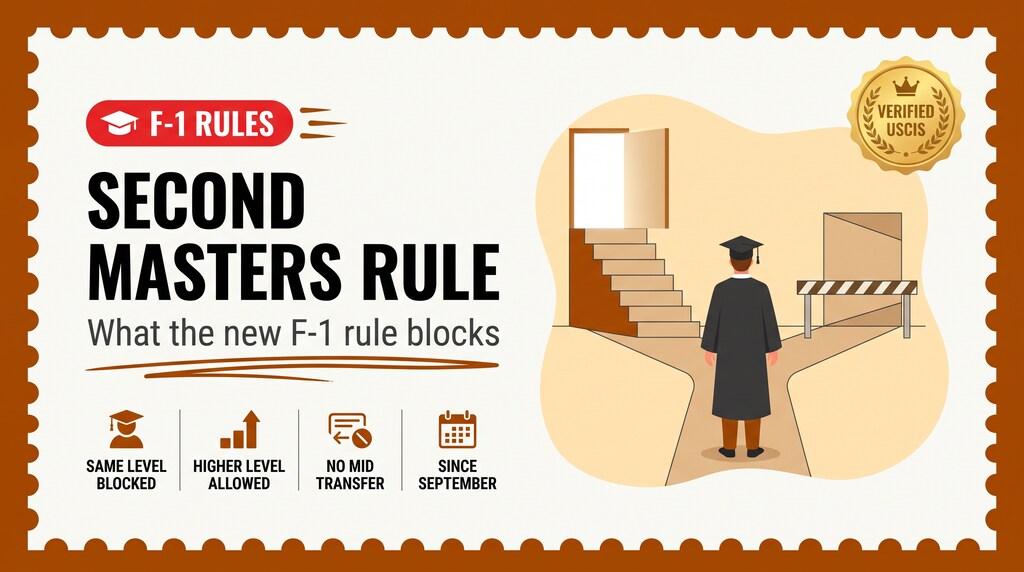
“An alien who has completed a program after September 15, 2026, in the United States as an F-1 student at one educational level may not maintain, be admitted, or otherwise be provided F-1 status through a program at the same educational level or a lower educational level.”
And 8 CFR 214.2(f)(5)(ii)(B) confirms the other direction still works: a student who completes a programme at one level and begins a new programme at a higher level is considered to be maintaining F-1 status.
| You completed a US programme after 15 Sept 2026 at… | Next programme | F-1 status? |
|---|---|---|
| Master’s | A second master’s | No — same level |
| Master’s | A bachelor’s or certificate | No — lower level |
| Master’s | A doctorate | Yes — higher level |
| Bachelor’s | A master’s | Yes — higher level |
Changing course mid-programme is restricted too
The same paragraph, (f)(5)(ii)(A), sets new limits on transfers and changes of educational objective:
- Graduate students (master’s and above) may not change educational objectives at any point during their programme, and may not transfer schools at any point unless SEVP authorizes an exception for extenuating circumstances such as a school closure.
- Students below graduate level may not transfer or change major or level within the first academic year, again unless SEVP authorizes an exception.
Why this matters for OPT
Practical training renews only at a higher educational level — the regulation says a student becomes eligible for another 12 months on changing to a higher level (see pre- vs post-completion OPT). A second master’s never brought fresh OPT on that basis; now it does not bring F-1 status either. The realistic routes after a master’s are OPT and the STEM extension, then H-1B via cap-gap, or a doctorate.
Can DHS delay it?
Yes. Under (f)(5)(ii)(E), until 14 September 2028 DHS may delay or suspend paragraphs (A) to (C) if it finds implementation infeasible. It must announce any delay in the Federal Register and on the SEVP website, and announce the new implementation date on the SEVP website at least 30 days ahead. A search of the Federal Register on 18 November 2026 found no delay or suspension notice; the rule as published is in force.
Questions to put to your DSO
- When did (or will) I “complete” my current programme for SEVIS purposes — before or after 15 September 2026?
- Does my planned next programme count as a higher level, the same level or a lower one?
- If I need more time in my current programme, how do I apply for an extension of stay? Under (f)(5)(ii)(D), a change in educational objective that needs more time requires an extension application to USCIS.
The rule reads plainly, but how SEVP applies it to individual records — especially programmes completed around 15 September 2026 — is a question for your school. More on the wider rule in our fixed admission period guide.
Questions
Can I do a second master’s on F-1?
Can I go from a master’s to a PhD on F-1?
Can I transfer universities during my master’s?
Has DHS delayed the same-level rule?
Sources: eCFR — 8 CFR 214.2(f)(5)(ii), school transfer and change of educational objectives · Federal Register — DHS final rule establishing a fixed time period of admission (17 July 2026) · eCFR — 8 CFR 214.2(f)(10), practical training