Can You Start Your Own Company on H-1B? The Beneficiary-Owner Rules
The regulation now says plainly that a company you control can be your H-1B employer — with three conditions that shape how a founder’s petition has to be built.
In this guide (5 sections)
For years the honest answer to “can I sponsor myself on H-1B?” was a long list of caveats. The regulation now addresses founders directly. Since the H-1B modernization rule took effect on 17 January 2025, 8 CFR 214.2(h) says what a company owned by its own H-1B worker must show — and what limits apply.
What makes a company an H-1B employer
A “United States employer” under 8 CFR 214.2(h)(4)(ii) is an organization in the US that:
- Has a bona fide job offer for you to work in the United States — which the regulation says may include telework, remote work or other off-site work within the US;
- Has a legal presence in the US and can be served with legal process here; and
- Has an IRS Tax Identification Number.
Nothing in that list excludes a company you own. A startup can be the petitioner.
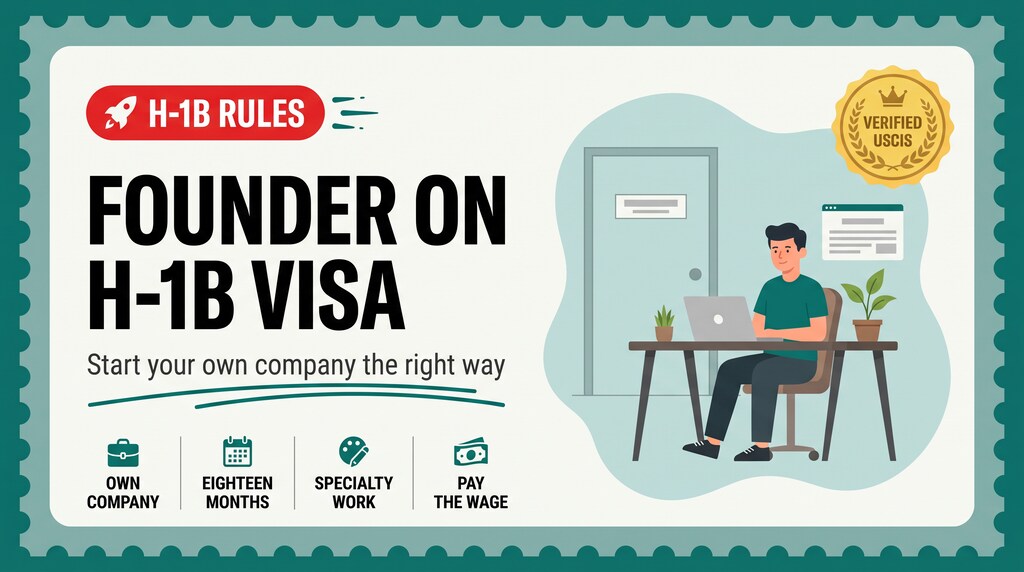
The three conditions for a founder-owner
The rules turn on whether you hold a controlling interest: owning more than 50% of the company, or having majority voting rights.
| Condition | What the regulation says |
|---|---|
| 1. Your duties | You may do work directly related to owning and directing the business, as long as you perform specialty occupation duties a majority of the time. |
| 2. First approval | Limited to a validity period of up to 18 months. |
| 3. First extension | Also limited to up to 18 months — including an amended petition that requests an extension of stay. |
The regulation limits only the initial approval and the first extension; ordinary H-1B validity rules apply after that.
What does not change
- The cap. A startup is not cap-exempt. Unless you were already counted against the cap, you go through registration and selection like anyone else — see our H-1B cap guide and how the weighted lottery works.
- The wage. DOL states that employers must pay H-1B workers at least the actual wage paid to similar workers or the prevailing wage for the occupation and area, whichever is greater. Your own company must pay you that, and attest to it on the Labor Condition Application.
- The job must be a specialty occupation, and you must qualify for it — the same tests as any petition.
- Fees and the six-year limit apply in full. Check our coverage of the $100,000 fee proclamation for whether it touches a new petition in your situation.
Why the 18-month limit matters for planning
Two 18-month approvals give you about three years to show the company is real before you are on normal validity periods. Each renewal is a fresh look at whether there is a bona fide job, a paying employer and specialty work. Plan the company’s payroll, books and your own role description around passing that test twice, not once.
What we did not cover
How USCIS weighs a startup’s ability to pay, which business structure works best, and tax or corporate law questions are outside what the regulation text answers. Those belong with an immigration attorney and an accountant. If you are on F-1 and thinking of founding first, read our OPT guide — and for a route that does not need an employer at all, compare O-1A and EB-2 NIW.
Questions
Can my own company sponsor my H-1B?
What counts as a controlling interest?
How long is an H-1B approval for a founder who owns the company?
Can I run the business while on H-1B through my own company?
Does a startup avoid the H-1B lottery?
Sources: eCFR — 8 CFR 214.2(h)(4)(ii), definition of United States employer · eCFR — 8 CFR 214.2(h)(9)(iii)(E), beneficiary-owned entities · US DOL Wage and Hour Division — H-1B program · Federal Register — Modernizing H-1B Requirements final rule (effective 17 January 2025)