The Weighted H-1B Lottery: How Wage Levels I–IV Now Decide Your Chances
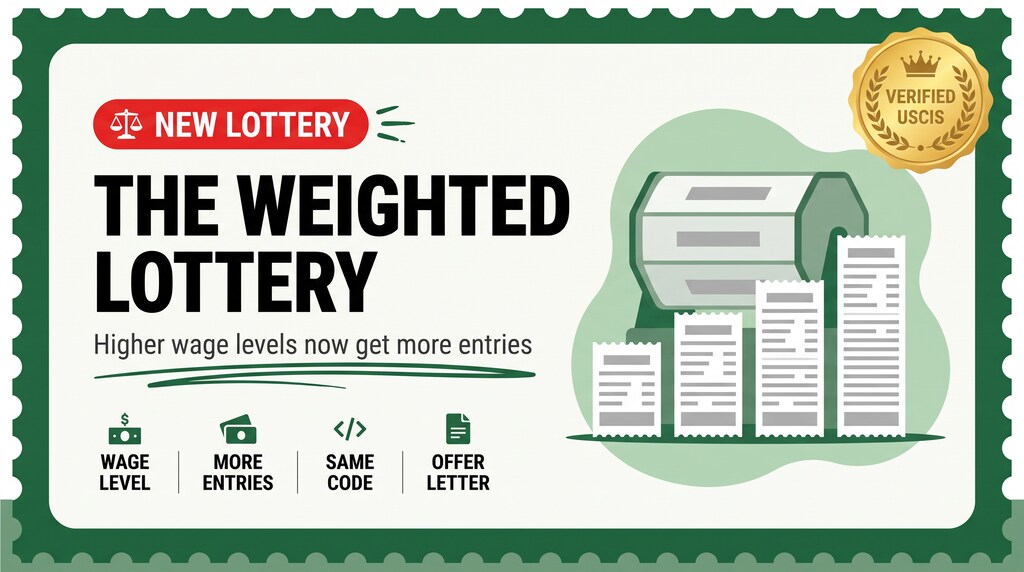
The H-1B draw is no longer equal. From FY 2027 a Level IV wage puts you in the pool four times and a Level I wage once. Here is exactly how USCIS assigns the level and what has to match later.
In this guide (4 sections)
For years the H-1B lottery treated every registration the same. That ended with the FY 2027 cap season. USCIS now runs a weighted selection that, in its own words, favours higher-skilled and higher-paid workers “while maintaining the opportunity for employers to secure H-1B workers at all wage levels.” For new graduates, whose offers usually sit at the lower levels, this is the most important change to the lottery in years.
How the weighting works
When USCIS gets more registrations than it needs — which is every year — each registration is assigned an OEWS wage level and entered into the selection pool that many times:
| OEWS wage level of the offer | Entries in the selection pool | Relative weight vs Level I |
|---|---|---|
| Level IV | 4 | 4× |
| Level III | 3 | 3× |
| Level II | 2 | 2× |
| Level I | 1 | 1× |
Each person still counts once toward the numbers USCIS needs, however many times they are entered and however many employers registered them. Selection is still by unique beneficiary, as it has been since FY 2025 — see our lottery odds by year for how that changed the numbers.
How your level is decided
The registrant must state the highest OEWS wage level that your offered wage equals or exceeds, for the job’s Standard Occupational Classification (SOC) code, in the area where you will work. Two things follow:
- Location matters as much as salary. The same salary can be Level III in one city and Level I in another, because the levels are set per area. Our salary data by role and city shows how much pay varies by location.
- The SOC code matters. A role coded as one occupation can land at a different level than the same pay under another code.
What has to match later
A selected registration is not the end of it. USCIS’s cap season instructions say the petition must:
- use the same SOC code as the selected registration and the Labor Condition Application;
- offer a wage that equals or exceeds the prevailing wage for the level claimed in that area;
- include evidence of the basis for the wage level chosen at registration.
If the registration and petition do not match, USCIS says it may reject or deny the petition. And at registration the employer signs an attestation, under penalty of perjury, that it is offering a salary at or above the level selected. A false attestation makes the registration improperly submitted — USCIS may deny or revoke the petition and refer the case to law enforcement.
What this means if you are a new graduate
- Your offer letter now affects your lottery odds. A higher salary relative to your occupation’s levels in that area gives you more entries. That is a real negotiating point — our prevailing wage analysis shows how far typical offers sit above the floor.
- Entry-level pay is usually Level I or II. See where entry-level offers fall by role in our 25th-percentile pay data.
- The master’s cap still helps. U.S. master’s holders still get a second draw for the 20,000 advanced degree exemption.
- Cap-exempt employers are unaffected. Universities and qualifying research nonprofits do not go through the lottery at all — see our cap-exempt guide.
Questions
What is the weighted H-1B lottery?
Does a Level IV wage guarantee H-1B selection?
Who decides the wage level on an H-1B registration?
Can the employer change the wage after selection?
Does the weighted lottery apply to the master's cap?
When did the weighted H-1B selection start?
Sources: USCIS — H-1B Cap Season (weighted selection) · USCIS — H-1B Electronic Registration Process