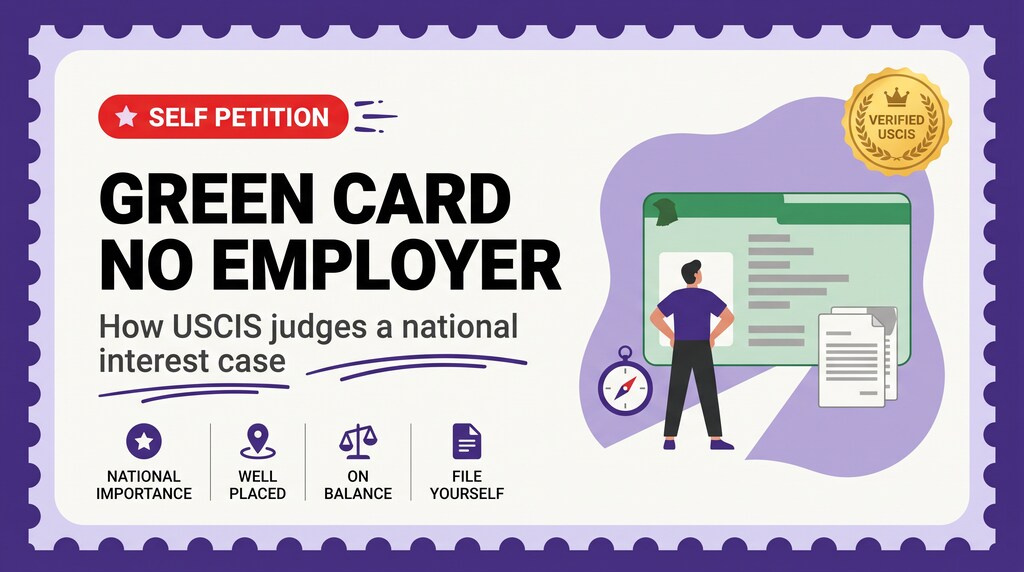
EB-2 NIW: The Self-Petition Green Card, and How USCIS Judges the Three Prongs
No employer, no PERM, and a far more reachable bar than EB-1A — if you can show your specific endeavour matters nationally. How USCIS actually reads an NIW petition, including the examples it says will not work.
In this guide (4 sections)
For Indian engineers and researchers, the National Interest Waiver (NIW) is the green card route that does not depend on an employer. You file your own petition, there is no PERM labour certification, and the standard is far more reachable than EB-1A. It is also easy to get wrong in a predictable way — and USCIS now publishes the examples it uses to reject weak cases.
Step one: qualify for EB-2 at all
NIW is a waiver within EB-2, so you must first fit one of its two sub-categories:
| Route | What USCIS requires |
|---|---|
| Advanced degree professional | A U.S. degree above a bachelor’s or its foreign equivalent — or a bachelor’s followed by 5 years of progressive experience in the specialty, which counts as a master’s. The occupation must be a profession requiring at least a bachelor’s. |
| Exceptional ability | Expertise significantly above the ordinary in the sciences, arts or business, shown by at least 3 of 6 criteria (degree, 10 years’ experience letters, licence, high salary, professional membership, recognition). |
Step two: the three prongs
USCIS evaluates the waiver itself on three factors, in order (the framework comes from the 2016 precedent decision Matter of Dhanasar):
1. Your endeavour has substantial merit and national importance
“Endeavour” means what you specifically plan to do — not your job title. USCIS says benefits to one employer, even a nationwide one, are not enough; the endeavour must have broader implications for a field, a region or the public. Its examples of what fails:
- a software engineer adapting their employer’s code for various clients, without evidence of broader impact;
- simply working in an occupation with a national shortage;
- a technology whose benefits stay with one company and its clients.
What can work, per USCIS: evidence of widespread interest in adopting or licensing the technology, a novel and important process, or impact on how other companies develop similar technology.
2. You are well positioned to advance it
Education, skills, a record of success in similar work, a plan you developed, progress so far, and interest from customers, users or investors. USCIS treats an advanced degree — especially a STEM PhD tied to a critical or emerging technology — as an especially positive factor. Expert letters help when they come from people with first-hand knowledge and are backed by independent evidence; a business plan alone is not enough.
3. On balance, waiving the job offer benefits the United States
Why it makes sense to skip the labour certification process in your case — for example, because it would be impractical for your kind of work.
How you file
You file Form I-140 yourself — USCIS says that for NIW petitions you may file on your own behalf. Instead of a certified PERM, the petition carries a completed Form ETA-9089 Appendix A and a signed ETA-9089 Final Determination. If approved, your spouse and unmarried children under 21 may follow in E-21 and E-22 status.
The part NIW does not solve
NIW removes the employer and PERM, but not the queue. An approved EB-2 petition still waits for a visa number based on your country of birth and priority date — see our guide to priority dates and I-140. Compare it with EB-1A in EB-1A vs EB-2 NIW.
Questions
Can I file EB-2 NIW without an employer?
Do I need a master's degree for EB-2 NIW?
What are the three prongs of the NIW test?
Can a software engineer get an NIW?
Does a PhD help an NIW petition?
What forms are filed for EB-2 NIW?
Does NIW avoid the green card backlog?
Sources: USCIS — Employment-Based Immigration: Second Preference EB-2 (NIW filing tips)