Duration of Status Is Gone: F-1 Students Now Have an Expiry Date
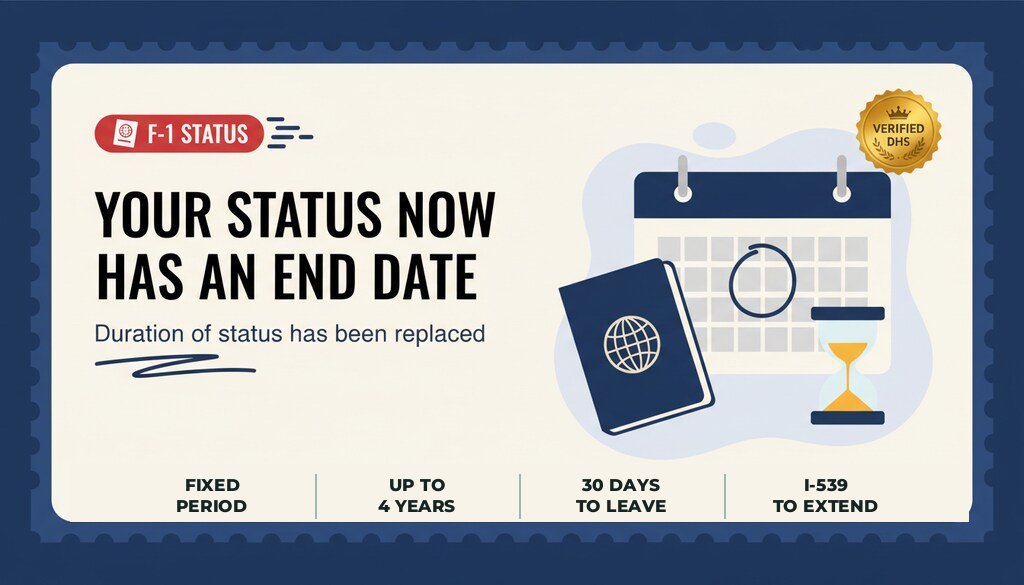
For forty years an F-1 I-94 said D/S and there was no date to miss. Now there is one, capped at four years — and the departure window has halved from 60 days to 30.
In this guide (5 sections)
For more than forty years an F-1 student was admitted for duration of status — written on your I-94 as D/S. It meant you could stay as long as you kept making progress in your programme. There was no end date to miss.
That is over. DHS has replaced it with a fixed admission period, and the change is already in force.
What changed
| Before | Now | |
|---|---|---|
| Admission period | Duration of status (D/S) — no fixed end date | A fixed period, not to exceed 4 years |
| Need more time? | Keep studying; update the I-20 | Apply to extend your stay (Form I-539) |
| After your programme ends | 60 days to prepare for departure | 30 days — new 8 CFR 214.2(f)(5)(v) |
| OPT start date | Up to 60 days after programme end | No more than 30 days after — 8 CFR 214.2(f)(11)(i)(D) |
DHS's stated reasoning is that it wants "predetermined points in time, not to exceed 4 years, for immigration officers to directly evaluate whether F-1 students are maintaining their nonimmigrant status and remain eligible". Those who need longer "may apply to extend their stay".
The three things that actually bite
1. Your I-94 now has an end date you can miss
Under D/S there was nothing to overstay as long as you stayed enrolled. Now there is a date, and the consequences of passing it are the ordinary consequences of overstaying.
2. A four-year cap is shorter than many programmes
A PhD rarely finishes in four years. Nor does a bachelor's followed by a master's, or any programme with a research extension, a medical residency, or a year out. Every one of those now requires an extension of stay filing — with a fee, a processing time and a rejection risk that did not previously exist.
Commenters on the rule raised precisely this, pointing out that filings every two to four years add cost and bureaucracy, and that when a filing is rejected after status has lapsed students "often cannot cure the gap, need to stop studying or working, and in some cases never regain the ability to return to school or work." DHS acknowledged the burden and proceeded anyway.
3. Post-completion OPT may now need an extension of stay
This is the part most directly relevant if you are planning to work after graduating.
DHS states plainly that it "acknowledges the commenters' concerns that applying for EOS to participate in post-completion OPT will represent an increased burden for some students but has concluded the change is appropriate".
So the OPT sequence can now involve two filings rather than one: the extension of stay to cover the period, and the Form I-765 for the EAD itself. Our OPT and STEM OPT guide covers the second; the first is new.
The 60-to-30 day change nobody is talking about
Two separate 60-day periods became 30.
- Preparation for departure after your programme ends is now 30 days under new 8 CFR 214.2(f)(5)(v). Half the time to pack up a life, close accounts, and leave.
- Your OPT start date may now be no more than 30 days after your programme end date, not 60.
DHS's reasoning for the shorter departure period is that it reduces overstays and strengthens oversight.
What to do
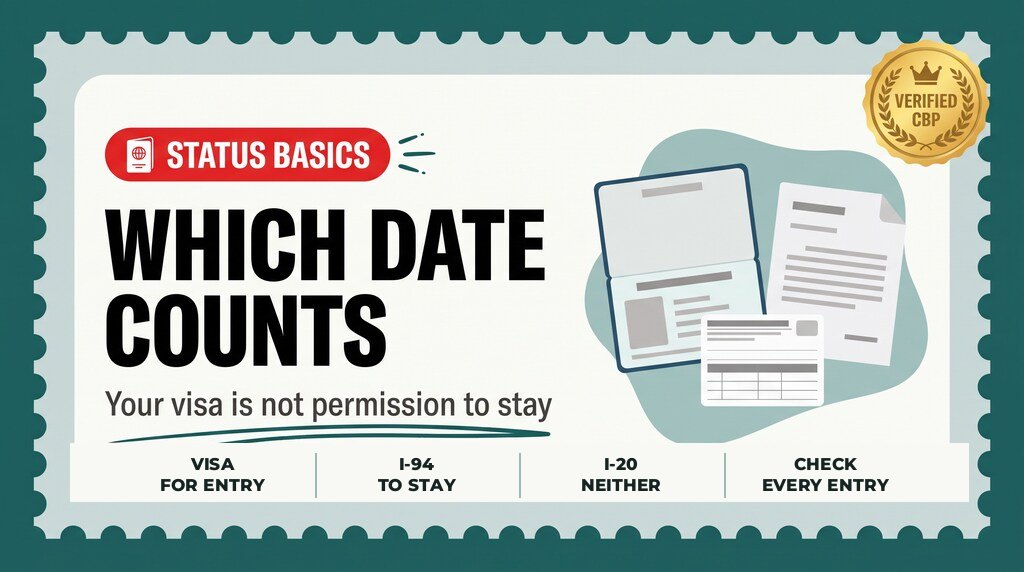
- Find your admit-until date on your I-94 now. Not your I-20, not your visa. Retrieve it from CBP's I-94 site and write the date down.
- Work out whether your programme finishes inside it. If not, you need an extension of stay, and you should find out from your DSO exactly when to file.
- Treat the 30-day departure window as real. Plan the end of your programme backwards from it.
- File OPT as early as you are permitted. The start-date window after your programme ends is now 30 days, so a late filing has far less slack.
- Re-check after every international trip. A new entry can produce a new admit-until date.
- Ask your DSO who files the I-539 and whether the school supports it. Commenters noted many schools will not do this work because it may constitute unauthorised practice of law, so the cost and responsibility may fall to you.
What we have not published
We have not published the filing fee for Form I-539, processing times, or the precise admission period for each category and programme type — those depend on your classification and on USCIS schedules that change. We have also not set out the transition provisions for students already admitted under D/S in detail, because the rule reserves discretion in that area.
And one genuine uncertainty worth stating: because this is a major rule subject to congressional review, DHS itself says the effective date could change or the rule could be terminated. It is in force today. Check the Federal Register document linked below before relying on any date, and take advice on your own situation.
Questions
Is duration of status gone for F-1 students?
How long is the new F-1 admission period?
What happens if my programme takes longer than my admission period?
How long do I have to leave after my programme ends?
Has the OPT start-date window changed?
Do I need an extension of stay to do post-completion OPT?
Which date governs — my I-94, my I-20 or my visa?
Could this rule still change?
Sources: Federal Register — Establishing a Fixed Time Period of Admission… for Nonimmigrant Academic Students, Exchange Visitors, and Representatives of Foreign Information Media (final rule) · CBP — Form I-94 Arrival/Departure Record · USCIS — Form I-539, Application to Extend/Change Nonimmigrant Status · ICE — Practical Training (CPT and OPT)