The H-4 EAD: When an H-1B Spouse Can Legally Work in the US
H-4 status alone confers no right to work. Eligibility turns on how far the H-1B holder has reached in the green card process — and one category-code mistake on Form I-765 can get an I-485 rejected outright.
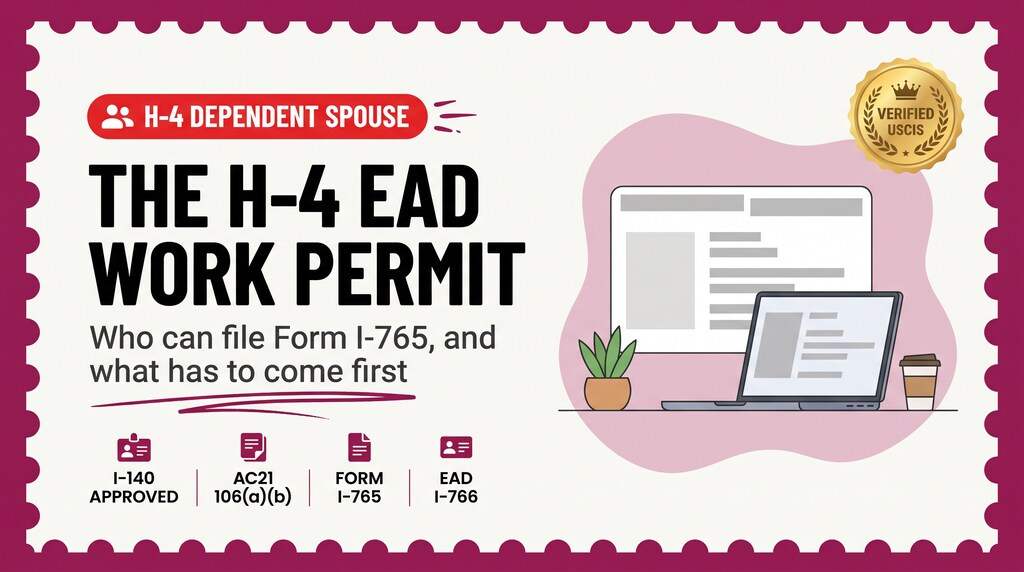
The H-4 is the dependent status held by the spouse and unmarried children under 21 of an H-1B worker. By itself it confers no right to work. A specific subset of H-4 spouses — and only spouses, not children — can apply for employment authorisation, and the qualifying condition has nothing to do with the spouse's own qualifications. It depends entirely on where the H-1B holder has reached in the green card process.
That is the part that surprises people, and it is the part that decides whether a household has one income or two.
Who is eligible
USCIS states that certain H-4 dependent spouses of H-1B nonimmigrants can file Form I-765, Application for Employment Authorization, if the H-1B nonimmigrant:
- Is the principal beneficiary of an approved Form I-140, Immigrant Petition for Alien Worker; or
- Has been granted H-1B status under sections 106(a) and (b) of AC21 — the American Competitiveness in the Twenty-first Century Act of 2000, as amended.
AC21 106(a) and (b) is the provision that lets H-1B holders pursuing employment-based permanent residence work and remain in the US beyond the six-year H-1B limit. So both routes point at the same underlying fact: the household is far enough into the green card process to have crossed one of two thresholds.
The two routes, and which one arrives first
These are not alternatives you choose between — they are two different points on the same timeline, and for most families the AC21 route arrives earlier.
| Route | Threshold | Typically reached |
|---|---|---|
| Approved I-140 | USCIS has approved the immigrant petition filed for the H-1B spouse | After PERM certification and I-140 adjudication |
| AC21 106(a) and (b) | H-1B granted beyond the sixth year on the basis of a PERM or I-140 filed at least 365 days earlier | Can be reached while the I-140 is still pending |
The second route is worth understanding properly, because it is frequently available before anyone realises it. USCIS describes two bases for establishing it:
- Based on filing of a permanent labor certification application. Evidence that the H-1B holder is the beneficiary of a PERM application filed at least 365 days before the AC21 period of admission begins. A printout from the DOL website, or other DOL correspondence showing the status, works as evidence. Important addition: if more than 180 days have passed since DOL certified the PERM, you must also submit the Form I-797 receipt notice for the I-140 showing it was filed within 180 days of that certification.
- Based on a pending Form I-140. Evidence that the I-140 was filed at least 365 days before the AC21 period of admission begins — shown with the Form I-797 receipt notice for the I-140.
You cannot work until the card is in your hand
USCIS is unambiguous: you must receive an Employment Authorization Document (EAD / Form I-766) from USCIS before you may begin working.
This is the opposite of H-1B portability, where filing itself authorises work. Here, filing authorises nothing. A receipt notice is not permission. The physical card and its validity dates are what an employer verifies on Form I-9, and starting before it arrives is unauthorized employment — with consequences that reach beyond the spouse, since unauthorized employment since last admission is one of the things that breaks H-1B portability for the worker later.
The filing mistake that gets applications rejected
There is a category-code trap in the I-765 that USCIS calls out in unusual detail, which is a reliable sign it happens often.
The H-4 EAD category is (c)(26). But if you are filing Form I-765 together with Form I-485 (adjustment of status), USCIS states you must specify your eligibility category as (c)(9), not (c)(26) — and pay the Form I-485 filing fee, following the I-485 filing instructions.
Get this wrong and the consequences are concrete:
- File the I-765 together with an I-485 at the filing address for category (c)(26), and USCIS will reject your Form I-485 and any corresponding fees.
- If you put the fees for both forms on the same check or money order, USCIS may also reject the Form I-765 for category (c)(26).
USCIS also states plainly that it will reject any application not accompanied by the proper filing fees or signature, and advises using the newest version of Form I-765 to avoid delays or a request for evidence.
The evidence checklist
USCIS sets out what each element of the application must prove:
| Evidence of… | Submit… |
|---|---|
| Your H-4 status | A copy of your current Form I-797 approval notice for Form I-539; or a copy of Form I-94 showing admission as an H-4 nonimmigrant or your most recent approved extension of stay |
| Photo identification | A copy of your last EAD (if any); the biometric page of your passport; a birth certificate with photo ID; a visa issued by a foreign consulate; or a national identity document with photo |
| Your relationship to the H-1B holder | A copy of your marriage certificate |
| Your basis for eligibility | Copy of the Form I-797 approval notice for the I-140; or the H-1B holder's passports, prior Forms I-94, current and prior Forms I-797 for Form I-129, plus the 365-day evidence described above |
| Photos | Two identical 2×2 inch passport-style colour photographs of yourself |
Translations
Any document containing a foreign language must be accompanied by a full English translation, certified by the translator as complete and accurate. For Indian families this most often means the marriage certificate, and occasionally a birth certificate. It is a small item that delays a large number of applications.
If you do not have the primary evidence
USCIS allows you to request that it consider secondary evidence — for example, the receipt number of the most recent Form I-129 extension of stay request filed for the H-1B holder, or the receipt number of the approved I-140. The agency warns directly that failing to provide necessary information about the H-1B nonimmigrant may result in delay or denial.
How to prepare, in order
- Establish which route applies. Approved I-140, or AC21 106(a)/(b) status. If neither, the EAD is not yet available and the question becomes when the H-1B holder's PERM or I-140 crosses 365 days — see how PERM and the I-140 actually sequence.
- Collect the H-1B holder's file: passports, all Forms I-94, all Forms I-797 for I-129, the I-140 notice, and the DOL PERM status printout.
- Check the 180-day item if relying on the PERM basis and certification was more than 180 days ago — you need the I-140 receipt proving timely filing.
- Collect your own documents: I-797 for I-539 or I-94 showing H-4 admission, photo ID, marriage certificate, two 2×2 photos, certified translations.
- Pick the right category code. (c)(26) standalone; (c)(9) if filing with Form I-485.
- Use the current form version, sign it, pay the correct fee, and keep payments separate.
- Wait for the physical I-766 before accepting any employment.
What we have not published
Filing fees and processing times are set by USCIS and revised — check the G-1055 fee schedule and the USCIS processing times tool rather than a number quoted anywhere else. We have also not covered automatic extensions of expiring EADs or the detail of concurrent H-4 extension filings, as those depend on your circumstances. Confirm them on USCIS or with an immigration attorney.
Questions
Who can get an H-4 EAD?
Can H-4 children work?
Do I need the I-140 to be approved?
Can I start working as soon as I file Form I-765?
Which eligibility category do I use on Form I-765?
What if I pay both filing fees with one cheque?
What evidence proves my relationship to the H-1B holder?
What if I do not have the H-1B holder's documents?
Sources: USCIS — Employment Authorization for Certain H-4 Dependent Spouses · USCIS — Form I-765, Application for Employment Authorization · USCIS — H-1B Specialty Occupations