Your EAD No Longer Auto-Extends: The Renewal Gap That Stops Your Pay
Filing your EAD renewal on time used to keep you working while USCIS decided. That bridge is gone. The rule, the dates, who it hits hardest, and the only lever you still control.
In this guide (5 sections)
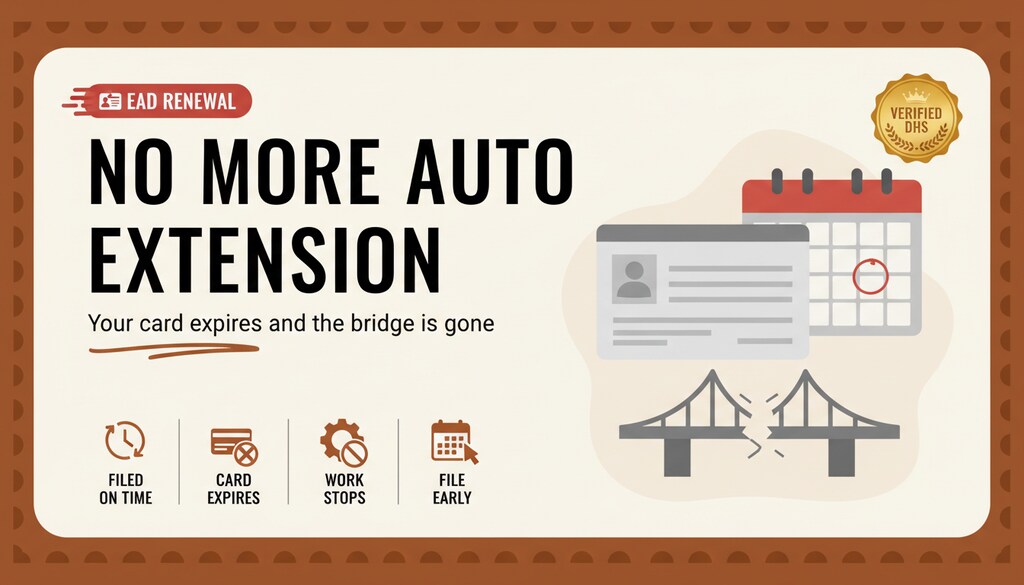
If you hold an Employment Authorization Document and you are planning to renew it, one assumption that used to be safe is no longer true: filing on time no longer keeps you working.
DHS has removed the automatic extension that used to bridge the gap between an expiring EAD and a renewal decision. The change went in as an interim final rule and has now been finalised, without changes.
What actually changed
The old rule lived in 8 CFR 274a.13(d). If you filed a renewal before your EAD expired, your employment authorisation and the document itself were automatically extended — for up to 540 days — while USCIS worked through the application. In practice that meant a backlog was the government's problem, not yours.
The new rule adds 8 CFR 274a.13(e). For renewal applications filed on or after 30 October 2025, that automatic extension no longer applies. The heading of 274a.13(d) was rewritten to make clear the up-to-540-day extension now covers only renewals filed before that date.
| Renewal filed before 30 Oct 2025 | Renewal filed on or after 30 Oct 2025 | |
|---|---|---|
| Automatic extension | Up to 540 days | None |
| Governing provision | 8 CFR 274a.13(d) | 8 CFR 274a.13(e) |
| If USCIS is slow | You keep working | You stop working when the EAD expires |
What this means in practice
Your authorisation now ends on the date printed on the card. If USCIS has not approved the renewal by then, there is no bridge. You stop working, your employer must stop you working, and you wait.
DHS states the purpose is benefit integrity and vetting — screening people before granting a new period of employment authorisation rather than extending it automatically. Whatever view you take of that, the planning consequence is the same: the filing date is now the only lever you control.
Who this hits hardest
- H-4 spouses with an EAD under 8 CFR 274a.12(c)(26). Note that even before this rule, an H-4 spouse was not eligible for an automatic extension where the EAD renewal depended on USCIS first adjudicating an H-4 status extension. Many H-4 holders were already exposed; now the fallback is gone entirely. See our H-4 EAD guide.
- Adjustment of status applicants waiting on a green card and working on an EAD while the priority date and I-485 grind on.
- Anyone whose renewal depends on another application being decided first. Two queues in sequence, with no bridge over either.
One category that works differently
L-2 spouses are worth separating out. DHS notes that an L-2 spouse remains employment authorised incident to status even after the EAD expires — but the expired card is no longer valid evidence of that authorisation for Form I-9 purposes. Once L-2 status itself ends, so does the authorisation.
So the L-2 problem is documentary rather than substantive, which is a meaningfully better place to be. Our L-1 guide covers how L-2S authorisation works.
What to actually do
- Find your EAD expiry date now and put it in a calendar with a reminder six months ahead. Not three. Six.
- File as early as the rules allow. The filing date is the only part of this you control, and every week early is a week of buffer.
- If your renewal depends on an underlying application — an H-4 extension, for instance — understand that you are waiting on two adjudications in sequence. File the underlying one first and as early as possible.
- Tell your employer early. They need to plan for a possible suspension, and a manager who hears about it in advance responds very differently from one who finds out on the day.
- Check current processing times for your form and category before assuming any buffer is enough.
- Do not keep working past the expiry date. Unauthorised employment has consequences well beyond the paycheck — among other things, USCIS states H-1B portability requires that you have not been employed without authorisation since your last admission.
What we have not published
We have not listed every affected category code or the exact filing window for each form type. The rule preserves exceptions where other law, 8 CFR 274a.13(d), or a Federal Register notice for TPS-related documentation provides otherwise, and the category list is the kind of detail that changes. Check your own category on USCIS, and take advice on your specific situation.
We have also not published processing times, because they move constantly and a stale number here would give false comfort — which is precisely the failure mode this rule creates.
Questions
Does my EAD still automatically extend if I file the renewal on time?
When did this become final?
What happens if USCIS has not decided my renewal before my EAD expires?
How does this affect H-4 EAD holders?
Are L-2 spouses affected in the same way?
How early should I file my EAD renewal now?
Can I keep working while the renewal is pending?
Why did DHS make this change?
Sources: Federal Register — Removal of Automatic Extensions for Certain Employment Authorization Documents (final rule, 14 Oct 2026) · USCIS — Form I-765, Application for Employment Authorization · USCIS — Employment Authorization for Certain H-4 Dependent Spouses · USCIS — Check Case Processing Times