H-1B Transfer: Changing Employers, Portability and the 60-Day Grace Period
You do not need an approval notice to join a new employer. What USCIS actually states about H-1B portability, the 60-day grace period, and the one job change that does send you back to the lottery.
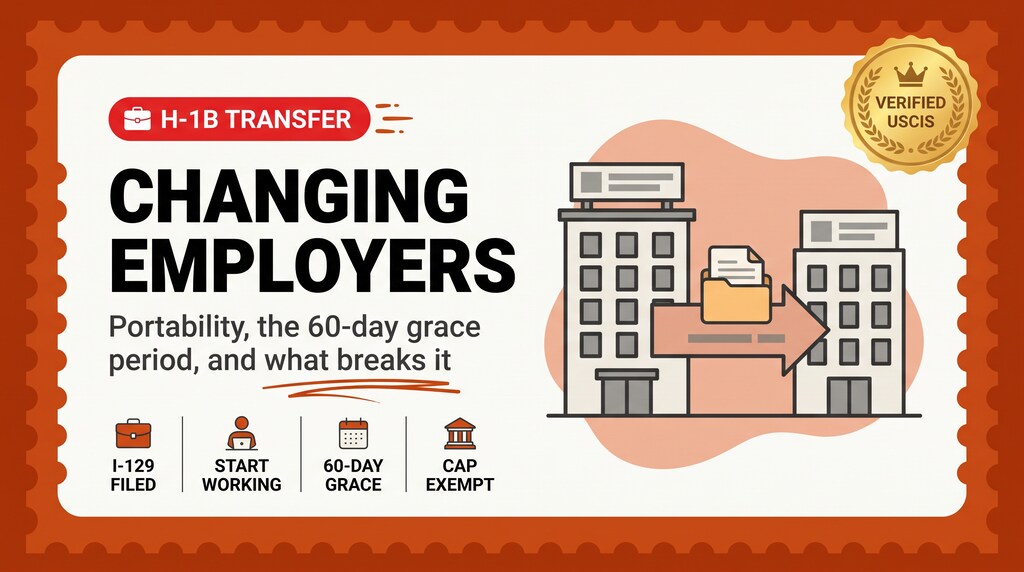
Changing jobs on an H-1B is the most common high-stakes immigration decision Indian professionals in the US actually make, and it is surrounded by more bad advice than almost anything else. People believe they must wait for an approval notice before starting. People believe a transfer re-enters the lottery. People believe a layoff means immediate departure. None of those is what USCIS states.
Here is the mechanism, in the order it affects you.
You do not need an approval to start work
The provision is called H-1B portability, and it is the single most useful rule in this visa category. USCIS states it directly:
Read the two halves of that. Filing is what unlocks work, not approval. But the requested start date on the petition can push it later — if the new employer files on 1 March asking for a 1 May start, 1 May is your date. You cannot work earlier than the date the petition itself asks for.
The two conditions attached to it
Portability is not automatic. USCIS sets out what you must satisfy:
- You must not have been employed without authorization at any point since your last admission into the United States.
- Your new employer must properly file a new, non-frivolous petition before your H-1B period of authorized stay expires.
The first is the one that catches people. Any stretch of unauthorized work — a gap worked through, a side arrangement, continuing after a status lapse — breaks eligibility for portability going forward. It is not cured by a later clean petition.
The second is a hard deadline, not a soft one. The filing must land while your authorized stay is still running. Not the approval; the filing.
What happens between filing and decision
USCIS states that if you are eligible for portability, your employment is authorized until USCIS makes a decision on the Form I-129. There is no gap, no pause, no interim document to obtain. The filing itself carries you.
Then two outcomes:
| Outcome | What USCIS states |
|---|---|
| New petition approved | You may continue working for the new employer for the period of time indicated on the new petition approval. |
| New petition denied | You may continue working for your previous employer, if your prior period of authorized stay has not expired. |
The 60-day grace period after a layoff
If your employment ends, USCIS states you may have up to 60 consecutive days, or until the end of your authorized validity period, whichever is shorter, to find new employment, change status, or depart the country.
Every word of that matters:
- Up to 60 days — a ceiling, not an entitlement.
- Consecutive — calendar days, running continuously. Not business days, and not resettable.
- Or until the end of your authorized validity period, whichever is shorter — this is the part most people miss. If your I-94 expires in 25 days, your grace period is 25 days. The 60 is capped by your existing validity.
And note what has to happen inside that window: a new employer must properly file a petition. Not interview you, not issue an offer, not promise to file. The filing itself has to be inside the window, which means the real deadline is weeks earlier than the one in your head — an employer's immigration counsel needs lead time to prepare an I-129.
A transfer is not a new lottery — unless the employer type changes
This is where a genuine distinction lives, and it is the one case where a job change does re-expose you to the cap.
USCIS states that institutions of higher education, related or affiliated nonprofit entities, nonprofit research organisations and government research organisations are not subject to the numerical cap. If you are employed by one of these, you are cap-exempt.
Moving between cap-subject employers while you already hold H-1B status does not put you back into the lottery. But moving from a cap-exempt employer to a cap-subject one does. USCIS is explicit: "If you are moving from cap-exempt to cap-subject employment, your new employer's H-1B petition will be subject to the H-1B cap."
That means the new employer must:
- Submit an electronic registration when the registration period opens — typically in March.
- Wait for selection. Registrants of selected beneficiaries are notified and selection notices are uploaded to their account.
- File the petition during the applicable filing period, with a start date of 1 October or later of the applicable fiscal year — and not more than six months before that start date.
Changing terms with your current employer
Portability is not only about new employers; USCIS groups it with changing employment terms with the same employer. Material changes to the job — and employers' counsel typically treat worksite location changes as material — can require an amended petition. The 2026 DHS fee rule references amended petitions explicitly, noting that the 9-11 Biometric Fee does not apply where a petitioner files an amended petition that does not seek to extend the worker's currently authorized H-1B or L-1 status.
The practical rule: if the job that was petitioned for is no longer the job you are doing, assume an amendment is in play and have the employer's counsel decide. Do not decide it yourself.
Fees your new employer may owe
Under the DHS final rule effective 9 September 2026, petitioners that are "covered employers" must submit the 9-11 Biometric Fee for all H-1B and L-1 petitions. A covered employer is one that:
- employs 50 or more individuals in the United States, and
- has more than 50% of those employees in H-1B, L-1A or L-1B status.
Form I-129 petitions postmarked or electronically submitted on or after 9 September 2026 must include the fees required under that rule. This is an employer cost, not yours — but it is worth knowing it exists if a smaller staffing-model employer hesitates over a transfer.
What to have ready before you resign
- Your current I-94 and its exact expiry date. Everything times off this.
- All prior I-797 approval notices, including from previous employers. The new petition needs your H-1B history.
- Recent pay records covering your current employment, establishing you have been working in status.
- Confirmation of the requested start date on the new petition — because that date, not the filing date, may be when you can actually begin.
- Your green card stage, if any. A pending or approved I-140 interacts with a job change in ways that depend on where you are in the process. See our guide to PERM, I-140 and priority dates for what each stage locks in, and raise it with counsel before resigning, not after.
The misconceptions, answered directly
| Belief | What USCIS states |
|---|---|
| "I must wait for approval to join." | No. You may begin as soon as the new employer properly files a non-frivolous I-129, or the requested start date, whichever is later. |
| "A transfer means a new lottery." | Not between cap-subject employers. Only moving from cap-exempt to cap-subject employment makes the new petition cap-subject. |
| "I get 60 days no matter what." | Up to 60 consecutive days or until the end of your authorized validity period — whichever is shorter. |
| "If the transfer is denied I have to leave." | You may continue with your previous employer, if your prior period of authorized stay has not expired. |
| "Unauthorized work in the past does not matter now." | Portability requires that you have not been employed without authorization since your last admission to the US. |
What we have not published
Processing times, premium processing availability and current filing fees change and are set in USCIS schedules — check the G-1055 fee schedule and the USCIS processing times tool rather than any figure quoted in an article. We have also not covered how a job change affects a pending adjustment of status, because that depends on specific provisions and on your individual case. That is a question for an immigration attorney.
Questions
Can I start working for a new H-1B employer before the petition is approved?
What are the conditions for H-1B portability?
What happens if my H-1B transfer petition is denied?
How long is the H-1B grace period after losing a job?
Does changing H-1B employers put me back in the lottery?
Which employers are cap-exempt?
Is my employment authorized while the transfer petition is pending?
What is the 9-11 Biometric Fee on H-1B petitions?
Sources: USCIS — H-1B Specialty Occupations · USCIS — H-1B Cap Season · USCIS — G-1055 Fee Schedule