
Table of Contents
Why “skills” matter more than degrees in the US tech market
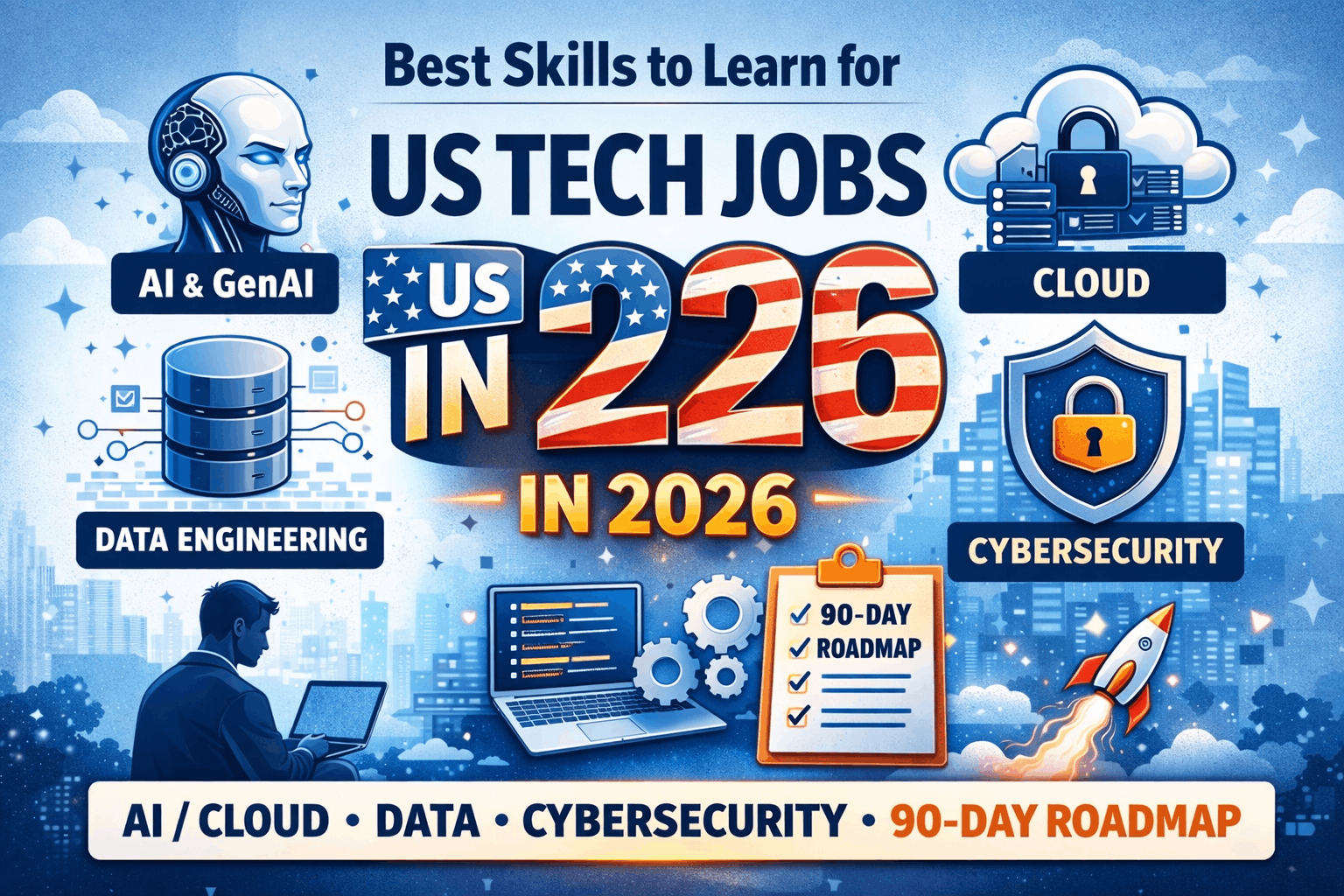
In 2026, recruiters shortlist faster than ever. Your advantage comes from proof-of-skill:
deployed projects, measurable impact, and the ability to work with modern stacks.
The strongest demand signals across reports point to AI + big data and cybersecurity, supported by cloud, engineering fundamentals, and strong communication. :contentReference[oaicite:1]{index=1}
Top skills for US tech jobs (2026) — what to learn first
These are grouped as skill clusters. Pick one primary + one supporting + engineering fundamentals.
| Skill Cluster | What US employers expect | Proof (projects) | Tools/Stack |
|---|---|---|---|
| AI / GenAI + LLM Apps | Prompting is not enough—build reliable apps: retrieval, evaluation, guardrails, latency/cost tuning. | RAG chatbot for a niche domain + eval dashboard + citations + safe outputs. | Python, APIs, vector DB, RAG, basic ML, app frameworks. |
| MLOps / LLMOps | Ship models to production: versioning, monitoring, CI/CD, drift, rollback. | Model pipeline → deploy → monitor → alert; include runbooks. | Docker, CI/CD, tracking, feature store concepts, monitoring. |
| Data Engineering | Clean, reliable data: ETL/ELT, warehouses, streaming basics, governance. | Build an end-to-end pipeline + quality checks + BI dashboard. | SQL, Python, orchestration concepts, warehouse/lakehouse basics. |
| Cloud (AWS/Azure/GCP) | Deploy and scale: compute, storage, IAM, networking, cost awareness. | Deploy your app + logging + monitoring + budget guardrails. | AWS/Azure core services, IAM, VPC, serverless basics. |
| Cybersecurity | Secure-by-design: auth, secrets, threat modeling, cloud security basics. | Secure API with OWASP checks + audit logs + incident playbook. | OWASP, IAM, SAST/DAST concepts, security monitoring. |
| DevOps / SRE | Reliability: CI/CD, infra as code concepts, observability, incident response. | CI/CD pipeline + SLOs + dashboards + rollback strategy. | Git, CI/CD, containers, monitoring, logs/traces basics. |
| Full-Stack Engineering | Deliver features end-to-end: APIs, performance, auth, UX basics. | SaaS mini-product with payments/mock + role-based access + tests. | JS/TS, React, backend framework, DB, testing. |
| Engineering Fundamentals | Data structures, system design, APIs, testing, debugging, writing docs. | System design writeups + load test + refactor notes + tests. | DSA, system design, REST, testing frameworks. |
Pick your lane: role → skill stack (simple mapping)
Portfolio projects that actually get shortlisted (US-style)
Best for AI/Full-Stack
- RAG over a domain dataset (policies / docs / course notes)
- Evaluation: answer quality + hallucination checks
- Security: red-team prompts + safe output rules
- Deploy on cloud + add analytics
Best for Data
- Ingest → transform → load (ETL/ELT) with validation
- Track data freshness and failures
- Dashboard showing business KPIs
- Write a short “Data Dictionary” doc
Best for Security
- Implement authentication + role-based access
- OWASP checks + rate limiting + secrets handling
- Audit logging + alerting rules
- Incident response doc (what to do when X happens)
Best for DevOps/SRE
- Automated tests + build + deploy pipeline
- Health checks + dashboards + alerting
- Define SLOs (uptime, latency) and measure them
- Rollback strategy and postmortem template
90-day roadmap (US tech job-ready plan)
- Daily: DSA basics + problem solving
- Core: Python + SQL (non-negotiable for most roles)
- Choose one lane: AI / Data / Cloud / Security / Full-Stack
- Start GitHub + write simple READMEs (US recruiters love clarity)
- Pick one “flagship” project from the Projects section
- Add tests + basic monitoring/logging
- Deploy (even simple) to cloud
- Write a 1-page case study: problem → approach → results
- System design basics (APIs, DB choices, scaling)
- Resume with metrics + links
- Mock interviews + behavioral stories (STAR)
- Apply consistently + network on LinkedIn
Resume + LinkedIn checklist (what US recruiters notice)
- Headline: “AI Engineer | GenAI Apps | Python | Cloud” (match your lane)
- Top 3 projects: each with link + 1 line impact (“reduced latency by X%” or “built pipeline for Y rows/day”)
- Skills section: group by categories (AI, Data, Cloud, Security, DevOps)
- Evidence: GitHub repos, deployed demos, short case studies
- ATS safety: simple formatting, consistent keywords, no heavy graphics
2026 trend signal (simple)
If you’re unsure what to pick: AI + data + security keep appearing as high-growth skills, and US projections show strong expansion in related roles.
Combine that with cloud deployment and fundamentals and you’ll be competitive. :contentReference[oaicite:7]{index=7}
FAQ (US Tech Skills 2026)
What are the best skills to learn for US tech jobs in 2026?
Market signals consistently highlight AI/big data and cybersecurity as fast-growing. :contentReference[oaicite:8]{index=8}
Is cybersecurity still a strong career in the USA?
Do I need a Master’s degree to get a US tech job?
What’s the fastest path for freshers?
Which is better in 2026: Data Engineering or Data Science?
About BeInCareer USA
BeInCareer USA helps students and professionals understand US career paths, in-demand skills, and job-readiness strategies through practical guides and curated updates.
(Informational content only—please verify requirements on official company or program websites.)
